What the Socratic Method Looks Like in a Grade 5 Classroom
Updated: Jun 8
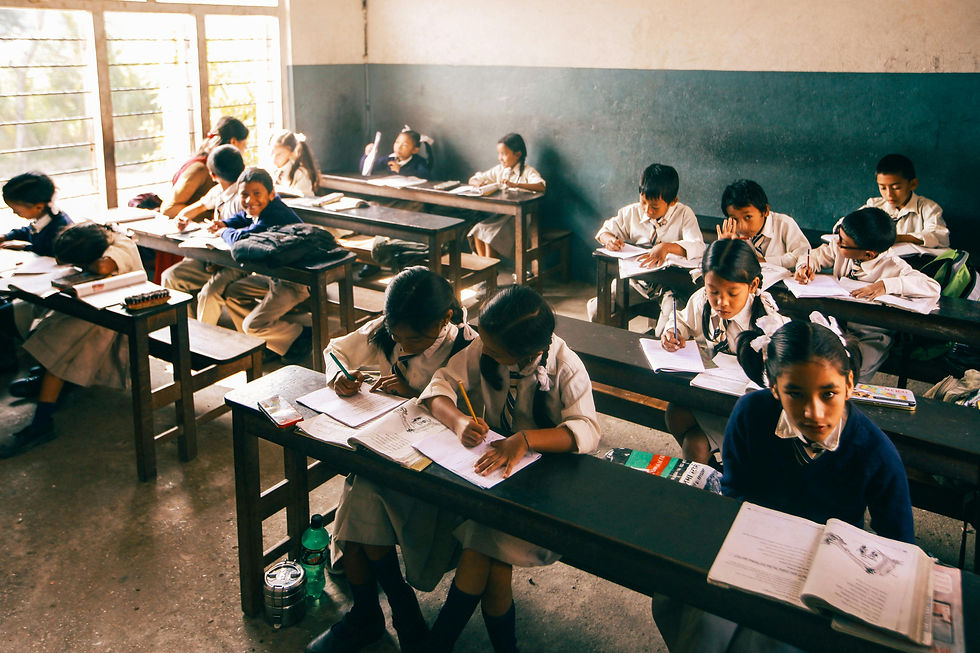
It is a Tuesday morning in a Grade 5 classroom at Avighna Academy. The children are gathered around a large table. In the centre is a globe, a torch, and a question written on a card: 'Why don't we feel the Earth spinning?' The teacher has not yet said a word. The children are already talking. 'Because it's too slow.' 'But it's going really fast, isn't it?' 'Maybe we do feel it and we just don't notice?' 'If you were on a train and it stopped suddenly, you'd feel it — so why don't we feel it when the Earth starts?' 'Does the Earth ever stop?' This is what Socratic learning looks like at Avighna Academy. Not a lecture. Not a worksheet. A conversation that the children are already, genuinely, invested in.
What Is the Socratic Method — Really?
The Socratic method takes its name from Socrates, the Athenian philosopher who believed that wisdom was not transmitted by an expert to an ignorant student — it was drawn out through careful, thoughtful questioning. Socrates did not teach by telling. He taught by asking, and then by asking again, and again, until his interlocutors had examined their assumptions, confronted their contradictions, and arrived at a deeper understanding of their own thinking.
In a modern classroom, this translates to a teaching style in which the educator's primary tool is not explanation but invitation: 'What do you think? What makes you say that? What would need to be true for that to be right? Can you think of a case where that wouldn't work?'
It sounds simple. It is, in fact, one of the most demanding pedagogical approaches there is — for teacher and student alike. It requires the teacher to genuinely not know what the child is going to say next. It requires the student to be genuinely uncertain, to think out loud, to risk being wrong.
And it produces, in the children who experience it regularly, something extraordinary: the ability to think.
A Classroom Walkthrough
Let's return to that Grade 5 classroom. The teacher, after listening to the children's initial hypotheses, picks one thread.
Teacher: Priya, you said maybe we feel it but don't notice. What would it mean to 'notice' something?
Priya: Like... you're aware of it?
Teacher: And when are you aware of something moving?
Arjun: When it changes? Like if the fan suddenly goes faster you notice it?
Teacher: Interesting. So you notice change, not constant movement?
Multiple children: Yes! That makes sense!
Teacher: So if the Earth has been spinning at exactly the same speed your whole life...
Divya: We wouldn't notice because it never changes!
Nobody told Divya the answer. She arrived at it herself, through a sequence of questions that dismantled her assumptions and rebuilt them on firmer ground. She will remember this moment — and this concept — long after a textbook explanation would have faded.
Why This Matters More Than Ever
We live in a world saturated with information. Any fact that a child might be expected to memorise in school is available in seconds on any device. The premium is no longer on knowing — it is on thinking.
The students who will thrive in the coming decades are not those who can retrieve information fastest. They are those who can evaluate information critically, synthesise ideas across domains, and ask the right questions of the data in front of them.
The Socratic method, practised consistently from the earliest years of school, builds exactly these capabilities. Children who have spent years learning through questions become adults who instinctively ask: 'But how do we know that? What are we assuming here? What evidence would change my mind?' These are the habits of mind that distinguish great scientists, lawyers, designers, doctors, leaders — and, most importantly, thoughtful human beings.
The Role of the Avighna Educator
Facilitation of this kind requires a very different skill set from traditional teaching. Our educators undergo extensive training not just in their subject areas but in questioning techniques, in managing productive uncertainty, in knowing when to push a conversation further and when to allow it to rest.
A particularly important skill is what we call 'tolerating the pause.' When a Socratic question is posed and a child falls silent, the instinct of most adults — trained in a world that rewards quick responses — is to fill the gap, to rephrase, to offer a hint. Our educators learn to wait. The silence is not failure; it is thinking.
Equally important is creating what researchers call 'psychological safety' — an environment in which children feel safe to be wrong, to contradict themselves, to change their mind publicly. A child who fears humiliation will never think out loud. Our classrooms are places where wrong answers are welcomed, because wrong answers, examined carefully, often turn out to be the most instructive ones.
Across Every Subject
The Socratic approach is not limited to science or philosophy. It is woven into every subject at Avighna. In mathematics, we ask: 'Does this formula always work? Can you find a case where it breaks? Why does this pattern exist?' In literature: 'What do you think the author wanted you to feel here? Do you agree with what the character did? Could the story have ended differently, and would that be better or worse?' In history: 'Whose perspective is missing from this account? If you had been there, what might you have done differently?' The questions change. The habit of mind remains constant.
What Parents Notice
The most consistent feedback we receive from parents of children in Socratic classrooms is a shift in dinner table conversations. Children begin to question — not in a combative way, but with genuine intellectual curiosity. They push back on information they encounter in the media. They ask for evidence. They say, 'But how do we know that?' This is not a sign of a rebellious child. It is a sign of a thinking child. And it is, perhaps, the greatest gift a school can give.
"At every PTM, I don't just hear about marks. I hear about who my son is becoming. That's everything." — Parent, Grade 6



Comments