Spaces That Spark Wonder: Inside the Avighna Campus Design
There is a question that architects of educational spaces have grappled with for centuries: what does a building teach? Every school is, in one sense, a curriculum. The height of the ceilings, the arrangement of the furniture, the presence or absence of natural light, the availability of materials, the existence of quiet corners and loud collaborative spaces — all of these things communicate something to children about how learning is supposed to happen and what kind of learner they are supposed to be.
When Avighna Academy was designed, this was not an afterthought. It was the first question.
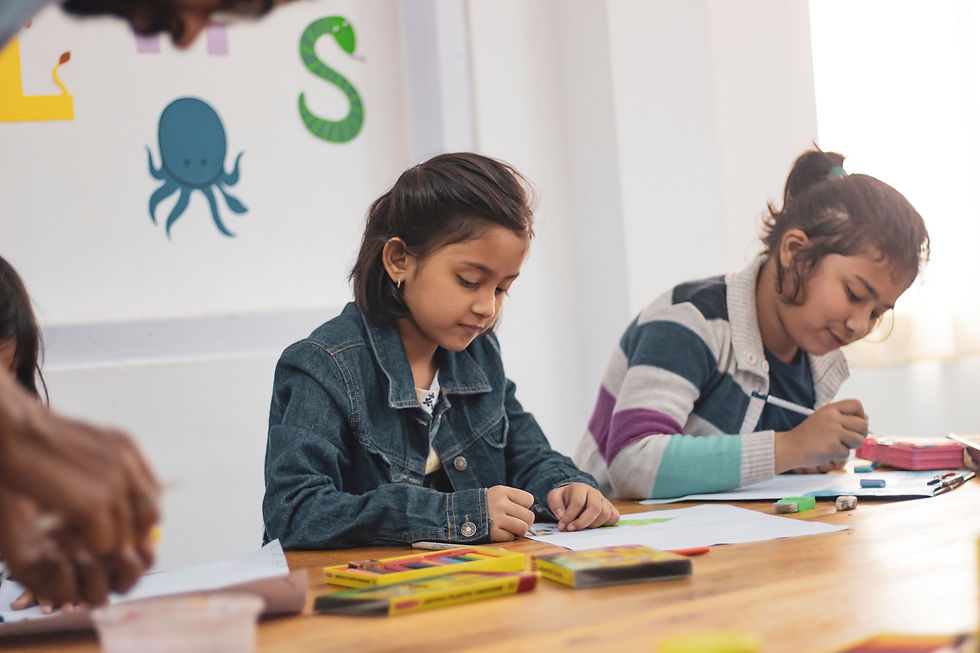
Starting With the Child
The design brief for Avighna's campus was unusual. Before a single floor plan was drawn, the team spent weeks in conversations — with educators, with parents, and with children. The question posed to children was simple: 'What would your perfect place to learn look like?'
The answers were remarkably consistent. Children wanted light. They wanted to be able to move. They wanted places to be quietly alone and places to be loudly together. They wanted to be able to touch things, make things, break things (safely), and fix them. They wanted to see their own work displayed — not as decoration but as evidence that their ideas mattered. They wanted, in short, a place that trusted them.
The Curiosity Cove
Perhaps the most distinctive space on the Avighna campus is the Curiosity Cove — a maker-lab for students in the early and foundational years. It is, deliberately, unfinished-looking. There are open shelving units stacked with materials: cardboard, wire, motors, fabrics, clay, seeds, circuits, measuring tools, and things that resist easy categorisation.
There are no step-by-step instruction posters. There are no right answers displayed on the walls. What there are is questions — big, open, genuinely difficult questions — printed on cards and scattered across work surfaces: 'How could you make this quieter?' 'Can you build something that uses wind?' 'What happens if you flip this upside down?'
The philosophy behind the Curiosity Cove is rooted in the work of educational theorists from Piaget to Papert: children learn most deeply by making and doing, by encountering genuine problems and wrestling with them until something works. The maker-lab is not a supplement to the curriculum; it is where much of the most important learning happens.
Story Grove
On the opposite end of the experiential spectrum from the Curiosity Cove is Story Grove — a reading nook designed to feel like a different world. The ceiling is lower. The lighting is warm and dappled. There are books at every height, on every subject, in three languages. There are beanbags and hammock chairs and a raised platform with cushions where a teacher can read aloud to a gathered group.
Story Grove is not a library in the traditional sense. Children are not required to be silent here (though they often choose to be). The space permits whispering, sketching, writing in response to what you have read. There is a wall covered in sticky notes where children post questions that a book has raised, and other children (or teachers) respond.
We believe deeply in the power of story — as a way of building empathy, of making sense of complex experience, of developing the linguistic richness that underlies all learning. Story Grove is the physical embodiment of that belief.
The Mind & Motion Arena
The connection between physical movement and cognitive function is one of the most robustly supported findings in educational neuroscience. Children who have regular, vigorous physical activity show measurably better attention, memory consolidation, and emotional regulation than those who are sedentary. And yet the instinct of most schools, as academic pressure mounts, is to cut physical education.
Avighna has gone the other direction. The Mind & Motion Arena is not just a sports ground — it is a learning environment. It hosts yoga and mindfulness sessions in the morning, athletics and team sports in the afternoon, and what we call 'movement-based learning' throughout the day: lessons that deliberately incorporate physical activity into academic content.
Children trace the water cycle by walking its stages across a mapped courtyard. They embody the movement of tectonic plates in pairs. They turn fractions into team challenges. The body is not separate from the learning mind; it is part of it.
The Horizon Hub
For students in the senior years, the Horizon Hub provides a space that feels less like a classroom and more like a professional studio. It is where passion projects are developed, where mentors meet students for one-on-one conversations, where presentations are prepared and delivered and critiqued.
The furniture is mobile. The whiteboards cover entire walls. The space has been designed to reconfigure itself around different modes of work: individual focus, small group collaboration, large group presentation. This flexibility is intentional — we want senior students to feel that the space is theirs to shape, because the ability to shape your environment is an important aspect of the agency we are trying to develop.
The Learning Environment Is the Message
Marshall McLuhan famously observed that the medium is the message. Applied to school design, this insight is profound: the building itself tells children what education means.
A school full of fixed rows of desks facing a single front of room says: knowledge lives up here; your job is to receive it. A school built around maker-spaces, reading nooks, movement areas, and collaborative studios says something very different: learning is something you do, everywhere, in multiple ways, with your whole self.
At Avighna, we have tried to build a school that says to every child who enters it: you are a curious, capable, creative human being, and this place was built for you.
"Our campus is a living curriculum — designed for discovery." — Avighna Academy


Comments